Optical Cables for Base-8 and Base-16 Applications
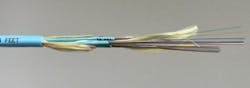
Proterial Cable America (PCA) recently introduced NanoCore Micro Distribution cables, manufactured for use in Base-8 and Base-16 optical connectivity networks and ideal for use in hyperscale data centers.
“Base-8 and Base-16 cables are top-of-the-line options for our customers,” said Joe Barry, PCA-New Hampshire’s chief operating officer. “This product is a great fit for hyperscale data centers, meaning our customers can expect more information and speed while using less space.”
When introducing the cables, PCA explained, “Modern transceivers typically contain 8 or 16 fibers, meaning the Base-8 and Base-16 cables align with them.” A Base-8 connector plugs into an 8-fiber transceiver, that transmits on 4 of the 8 fibers and receives on the other 4 fibers. Likewise, a Base-16 connector plugs into a 16-fiber transceiver, which transmits over 8 fibers and receives over 8 fibers.
“Specially designed to transmit data at high speeds, Base-8 and Base-16 cables have a PVDF jacket, versus a standard PVC jacket, making them smaller than the Base-12 alternatives, allowing more cables to fit in the same space,” PCA further explained. “This cable is also available in a single unit option with up to 16 fibers.”
The NanoCore Micro Distribution cable includes 250-micron fiber in a loose tube design. In each cable, all fibers are used for parallel-optics applications in support of 40GbE, 100GbE, 400GbE, 800GbE, and 1.6TbE.