Splice Terminal Houses Up to 288 Mass-Fusion-Spliced Fibers
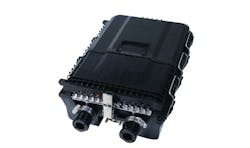
AFL’s RTD Splice Closure supports the installation of up to 12 individual drop cables with a midspan entry on a distribution cable. It allows for up to 288 mass-fusion-spliced fibers, or up to 96 single fiber splices.
It supports connector types including SC/APC, SC/UPC, LC/APC, and LC/UPC. Fiber fanout kits are offered as single-fiber or ribbon-fiber versions. Fanouts and adapters are included in the base configurations; the closure comes with two splice trays standard.
The closure has separate compartments for splicing and drop access with a lockable splice storage area to prevent unnecessary access. It also features a lockable, articulated hinged drop access lid with a hold-open feature. Accessing this area allows the addition of drops for new installations.
The RTD Splice Terminal features an IP68 rating to 6 feet of water head, enabling below-grade installations.
It accepts distribution cables from 0.25 to 0.83 inches in diameter without having to change the grommet size for sealing. A gel material seals around drop cables, which allows numerous re-entries into the drop area without degrading the seal.
The closure can be mounted to a pole, a 12x12 pedestal, below grade, a wall, or aerially. The BEAD-compliant product is compatible with AFL’s MicroCare Cable, CB-30 Coil Bracket, and CB-AX2SH Coil Bracket.